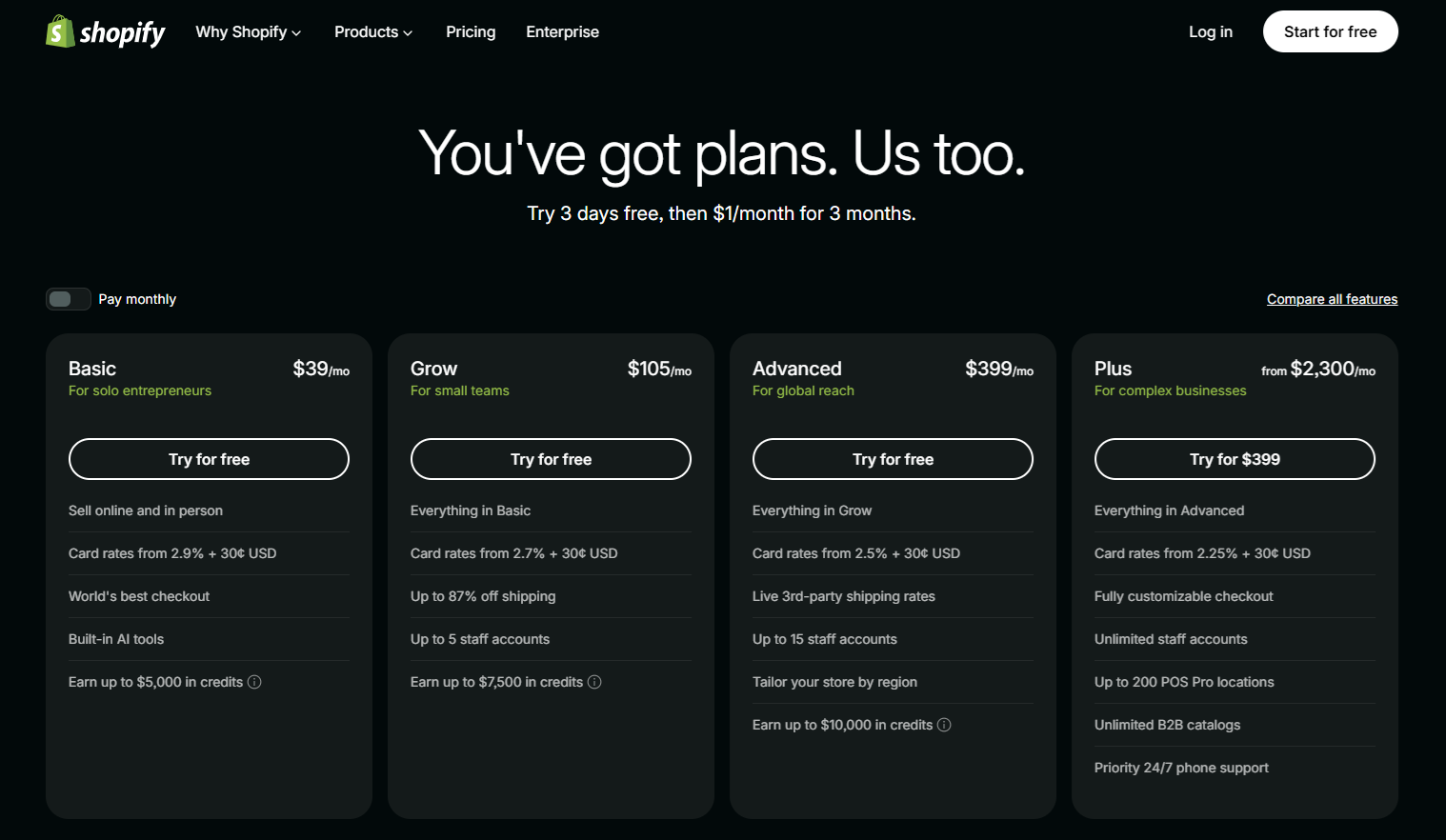
Shopify Pricing
Squarespace Pricing
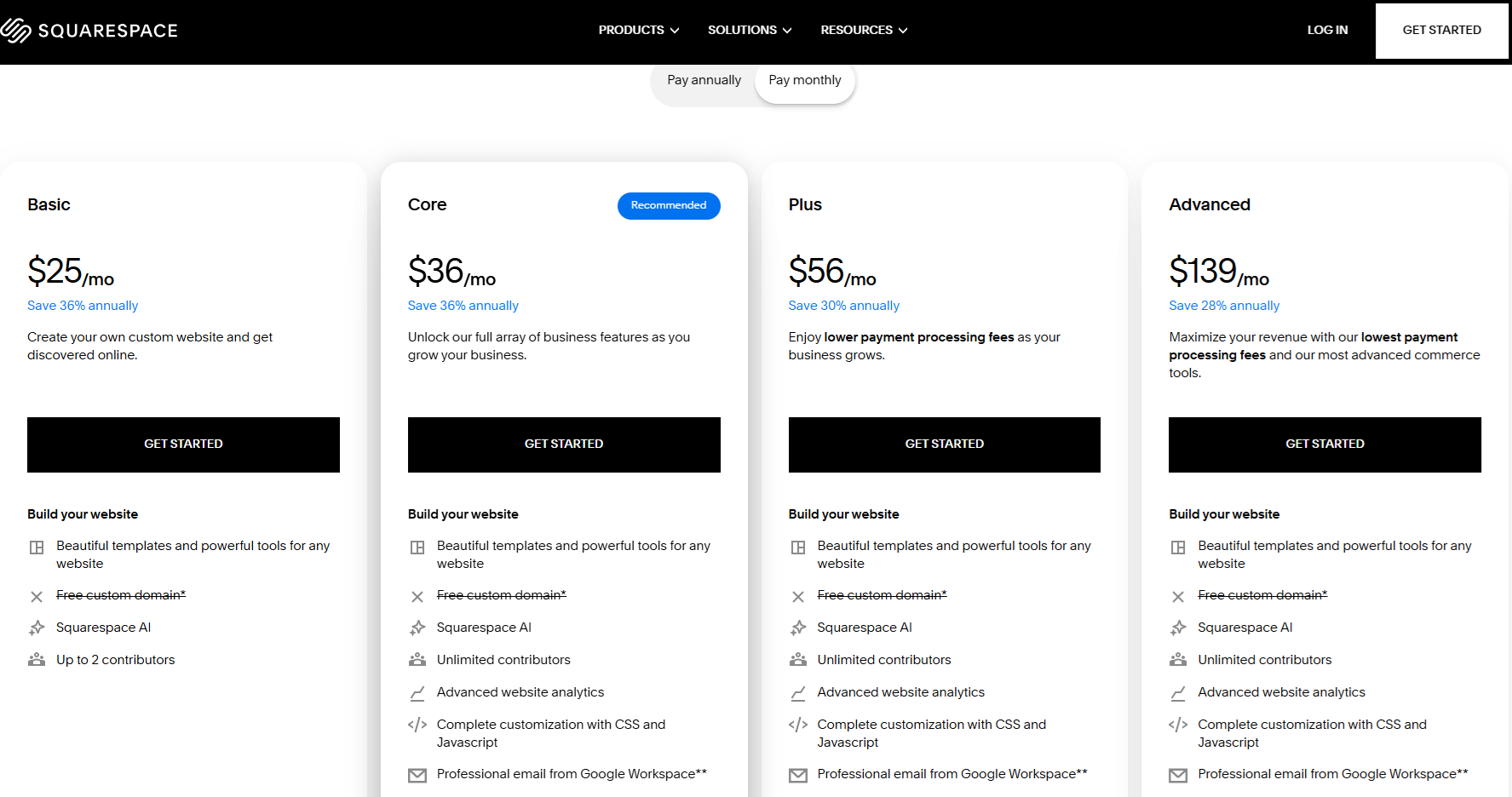 Note the pricing page was accurate at the time of filming but may have since changed. You can see the latest version by clicking here.
Monthly Plan Pricing (Core Comparison)
| Plan Tier | Shopify (Monthly) | Squarespace (Monthly) |
|---|---|---|
| Entry / Basic | $39 | $25 |
| Mid-tier | ~$105 (Grow) | $36 (Core), $52 (Plus) |
| Advanced | $399 | $139 |
| Enterprise | $2,300+ (Plus) | Get In Touch |
Key takeaway:
- Squarespace is significantly cheaper across all tiers
- Shopify becomes much more expensive at higher tiers
Annual Discounts
- Shopify: ~25% off
- Squarespace: Up to ~36% off
Example (annual pricing):
- Shopify Basic: ~$29/month
- Squarespace Advanced: ~$99/month
Squarespace offers larger savings when billed yearly.
Payment Processing Fees
Standard Online Payments
| Plan Level | Shopify | Squarespace |
|---|---|---|
| Entry | 2.9% + 30¢ | 2.9% + 30¢ |
| Mid-tier | 2.7% | 2.7% |
| Advanced | 2.5% | 2.5% |
Key takeaway:
- Very similar at higher tiers
- No clear winner here at scale
Extra Transaction Fees
Shopify
- +2% (Basic) → 0.6% (Advanced) if using 3rd-party payments
- 1% international card fee
- Additional hidden fees for premium/corporate cards
Squarespace
- +2% fee on Basic plan only
- No extra fee on higher plans
- 1.5% international card fee
- Digital product fees:
- 7% (Basic)
- 5% (Core)
- 1% (Plus)
- 0% (Advanced)
Key takeaway:
- Shopify penalizes external payment gateways
- Squarespace penalizes digital products (on lower tiers)
- Shopify is cheaper internationally (1% vs 1.5%)
Entry-Level Options
Shopify
- Free trial → then $1/month for 3 months
- Starter plan: $5/month (social selling only)
Squarespace
- 14-day free trial
- No ultra-low starter plan
Key takeaway:
- Shopify is better for testing cheaply
- Squarespace gives more time to evaluate (14 days)
POS (Point of Sale)
- Shopify: $89/month (POS Pro add-on)
- Squarespace: Included in plans
Key takeaway:
- Shopify charges extra for advanced POS
- Squarespace includes POS features by default
International & Currency Fees
| Fee Type | Shopify | Squarespace |
|---|---|---|
| International cards | 1% | 1.5% |
| Currency conversion | (Not clearly stated) | 1% |
Key takeaway:
- Shopify is cheaper for global selling costs
Hidden / Additional Costs
Shopify
- Premium card surcharges (not clearly advertised)
- App store costs (common in ecosystem)
- POS upgrades
- Third-party payment fees
Squarespace
- Digital product transaction fees (lower tiers)
- Domain costs on monthly plans
Overall Pricing Verdict
Squarespace Wins On:
- Lower monthly cost (all tiers)
- Better annual discounts
- No extra transaction fees (on higher plans)
- Built-in features (fewer add-ons needed)
Shopify Wins On:
- Lower international transaction fees
- Better for large-scale businesses
- More advanced ecommerce infrastructure
- Strong POS + omnichannel selling (but costs extra)
Find out More
Click here to visit the Shopify Website
Click here to visit the Squaresapce Website
Full video Transcript:
Today we’re going to compare Shopify and Square Spaces pricing plans. So, we’re going to have a look here. We’ll start off with Shopify, which is the dominant player in the space. They give you the option to start for free. Then you can pay just $1 a month for three months. And then they have a variety of plans beyond that.
Let’s get into it here. Okay, so we’re looking at the monthly price. They offer discounts for yearly, which we’ll look at in a minute. But let’s start with the month the monthly plans here. Their basic plan, which is kind of the simplest thing, is $39 a month. And at, for that, you can process transactions at 2.9% plus 30 cents for online, 2.6% plus 10 cents per transaction in person.
And then there’s a 2% additional fee for third party payment processors. That’s if you don’t want to use kind of Shopify’s integrated payments options. There’s a variety of kind of features that they have here. We’ll maybe have a quick look at those in a moment. Their next level up is their grow plan which the price jumps up to over $105 per month.
You get a bit of a discount here. So, you go to from 2.9 to 2.7% for online transactions, and from 2.6 to 2.5% for in-person transactions. And your third-party payment processors drops from a 2% surcharge to just a 1% one.
And again, you have different kind of other features here going up. They offer an even more kind of advanced plan, which is, appropriately enough called the advanced plan. It’s $399 per month. Again, you drop down on transaction fees from 2.7% down to 2.5% from 2.5% for in person, down to 2.4% in person.
And they charge us a 0.6% third party payment processing fee. And then if you want to go up to their kind of top tier plus plan.
The price really jumps up here. This starts at $2,300 per month, and that’s on a three-year term. You do get much better bespoke payment pricing. For really big transactions or really big merchants, it can be a savings. But yeah, that’s a pretty hefty price tag.
And if you go down here, they also offer a, just a very basic starter plan, which is just for social media and messaging and apps, which is just $5 a month. And they offer a POS pro plan, which is $89 a month which you can also kind of look into. So, if you look at the paying yearly fee here, that its price drops by 25%.
We have 29. 79, 2 99. But this plus plan still stays the same at 2,300 dollars per month at a minimum. If we look at the full list of features here, we’ve got the online store across everything. They have their own checkout across everything. You could put as many products in as you want.
Staff accounts. There’s only one. There are no additional ones on the basic plan. But then they go up from there, have collaborator accounts, they have all their whole theme and template library. They have also. Of sales channels that you can do here. So everywhere, social media, online marketplaces they have analytics across everything.
Support is live chat for the basic things. And then there’s enhanced live chat. And then you can get phone support for the highest tier plans. In terms of web hosting, it’s unlimited across the board, custom domain across the board. You get a free SSL certificate across the board, which is standard.
All of the plans include in-person selling as well, so not just selling online. And then you have these options here to have at more advanced kind of POS systems installed here, which is that $89 per month we saw before. And then there’s email forms their own inbox offering discount codes across everything.
Gift cards can be used across everything. You can do different campaigns across everything. And then we have here, the standard card rates and then it should be noted here though, that they are, they do charge an amount for premium cards, which is not advertised before. So, for, these are for commercial cards and corporate cards.
Obviously, all those cash back and points that you get from using your credit card, that has to come from somewhere. This is where you’re paying it sort of thing. You can see here that there’s, an additional charge here. Again, as your plan goes up, you do pay less. And then if you’re paying with international cards there’s a 1% surcharge across the board there as well.
Getting from everybody pretty hefty for some of these things here. You could with a I’m not sure. I guess if you had a premium cashback card let’s say an Amex card and you’ve got, say, a customer, you’re in the US and you sell to somebody in the UK, I guess you could be paying as much as 4.5% plus say 30 cents for transactions.
It definitely adds up. They also have, PayPal wallet rates here. You can accept this is crypto stable coin. Things here. This, these USDC rates. Again, you can see the in-person rates and then manual entering rates. And then there’s fraud analysis across everything.
You get some discounts here and then you have the marketplace across everything. And I think you can have these kinds of synced orders across, like this is in physical and online kind of marrying those things up together. Got the app store that they have here.
There’s a bunch of e-commerce automations. And then there’s so they offer language cancellations on your store as well. Currency conversion for customers, which is great if you, it’s really useful if you’ve got customers else located elsewhere in the world that they can know what the price is in their own currency.
Also, it helps conversion rate, generally speaking, if you’re able to offer pricing in the local currency. So, you have local payment methods here. Again, depends on where you’re selling option of having local domains across all plans. Duty and import taxes. Obviously with these kinds of tariffs that are going on in the world right now, helping to have that is really useful.
If you want to have local storefronts though, you got to go for the higher tier plans to have that. They are off also offering interest on your savings or your balance that you have there. So same across the board, unless you’re on the top tier plan where you get a little bit of a boost there.
They have a Shopify credit, Shopify bill pay, and then there’s tax calculations, which they help you with. Tax liability tracking, easy product, categorization. Free. Okay. So, they’re offering okay, so the tax here for the first a hundred k in sales, they offer that for free. So, the first a hundred K is free and then just 0.35% after, and that’s across all the plans, except drops down to just 2.25% for their top tier plan.
Then they have a whole bunch of other things here, so you can see. All sorts of features here. And you can get started for free with them and I’ll link to that offer in the description below. Now, let’s jump over to Squarespace, which is probably Shopify’s biggest rival. Okay. So, we’re again looking at the pay monthly plans here, not the pay annually.
Remember, if we go to pay monthly, the cheapest plan at Shopify’s $39 a month, whereas if we’re paying monthly, the cheapest plan at Squarespace is $25 a month a bit cheaper. And they offer savings at 36% annual savings. A much bigger savings than Shopify does. They offer templates just Shopify does in their own sort of things.
They offer ai, they give you two contributors here on their basic plan. They don’t give you the free custom domain if you’re only on their monthly plan, which seems a bit cheap to me, that they wouldn’t just offer you domain. If honestly one month at $25 is, it’s enough, more than enough to pay for a domain.
Also, I should note before con continuing on here, that the, that Squarespace offers their plans free for 14 days, whereas Shopify’s plans are from school all the way to down here. It is, you can try it for three days with no credit card return or required. Squarespace is giving you a full two weeks to get things set up and see if how you like them here.
Transaction fee is very similar here again. So, 2.9% plus 30 cents for the standard card of rates an online store transaction fee. Okay, this is an additional 2% on top of that. So that’s expensive on their plan here. And then they have digital content. And these are sort of things that are digital downloads, which they offer to you, but there’s a 7%.
Charge there so you can also send invoices and sell products and services and content and membership. Going to give you the full range, or if you’re trying to sell digital products, they have a more kind of native integration there. And then if we look across here, their next plan app is $36 a month.
And this is again on the monthly plan. Then their plus plan is $56 a month. Again, like all of these plans are on the whole cheaper than Shopify. And even their advanced plan is just $139 a month, which you jump back up here to Shopify and their advanced plan is $399 a month.
A lot less money when you’re doing that again. If you go pay annually, you pay even less. The advance amount comes in at just $99 a month with their 28% annual discount. Again, they, there’s not on their kind of core plan, which is their jump up here. There’s no discount in transaction fees.
They no longer take a cut though there, and they’re cut on digital products of 5% is lower than on their kind of basic plan. The reason why this is going to be charged higher that you risk of fraud for digital products is quite a bit higher than for physical products. And then they have these kind of various.
Features you can see here going up to $39 a month. This is again, now, we’re now on the annual thing here. Again, you have all the templates, you have the custom domain, unlimited contributors, which is nice. You got the analytics, you can do you can customize with CSS and JavaScript, which is something that Shopify traditionally has been known not to do.
I think there’s now ways to work around it. But they’re really using this as an advantage here that you give, you’re given more kind of control over things. They also start on this plan here to start reducing their transaction fees down to 2.7% and 30 cents. They’re no longer taking any additional thing and just a 1% surcharge on digital products.
And then finally here on their advance plan, you have all the same sort of things. And again, a down to as low as 2.5% plus 30 cents for standard transaction fees. Which is the same as what you the same rate as you would get on Shopify’s advanced plan, which is an extra three sorry, an extra $200 a month on the annual pricing compared to square piss space’s annual pricing.
Squarespace is a fair bit cheaper just in terms of monthly costs and comparable on transaction fees. Once you’re up at this level here, then they’re not charging you anything extra. Let’s just have a really quick run through there, kind of feature list. Got a bunch of templates across all plans, drag and drop editor across all plans.
Custom domain when you’re on the annual, you get it. Obviously when we saw it on the monthly, they don’t give it to you, they charge you for it. Mobile optimized websites, which just like table stakes now, but has it there. SEO features are there. 24 7 customer support. I’m not sure what that actually means, if that’s just a chat or not.
They don’t specify their ai, which it could be almost anything. They offer specifically video hosting a storage. 30 minutes there from the basic plan all the way up to unlimited on the advanced plan. Bandwidth is unlimited across all plans. The contributor limit here is just two on their basic plan, but then unlimited across everything else.
Shopify tends to. Was stricter of that security. Same across everything. They’ve got their extensions; they’ve got a CSS editor. If you really want to customize how things look you can accept donations here. And then we go down. And so, payments here are great. Here we go. Comparing payments.
Their premium payments here on their basic plan are 3.2% plus 30 cents per transaction. And if we go down here, what is it here? I remember it was 3.5%, 30% solid. Even on their cheapest plan, the premium cards are getting charged less. And so, it’s still 3.2% and 30% there, which is still lower than there.
And then it’s pretty much across the board it’s the same. You do save a little bit the very high end here, but again, you’re paying a lot more per month. There. And then you, as you can see here, there the kind of standard rates are there, international credit card processing rates. Okay? 1.5% on there on across the board here, which compares with.
Shopify at just 1%. Something to consider if you have a lot of international orders is that you will be potentially paying a bit more here for that. Currency conversion transaction fee is 1% across the board. I’m not sure if Shopify mentioned how much that is there. I don’t see it here. If anybody does see it, just to comment on the comment section below.
They have POS point of sale integration across the board here. Online store transaction fees are 2%. Remember we saw that before on top of the credit card processing fees for the basic plan, but then nothing across else. And then you for digital content transactions, 7, 5, 1, and zero. You can send links to collect payment and then no transaction fees if you’re paying by invoices.
They’ve got e-commerce. Again, unlimited product and services. Gift cards, again, we saw similar to Shopify, you can send invoices, you can sell courses, blogs, video membership and subscriptions, which is not something that Shopify is really designed to do. Whereas Squarespace is obviously leaning into this space you can check out on your own domain, which is something, again, that’s different from Shopify.
They tend to have their pricing page quite locked down, but they obviously have it dialled into conversions at least across most merchants. Depends how comfortable you are customizing stuff yourself. Again, they’ve got the social media selling Shopify’s that abandoned cart recovery seems to be standard here, which I don’t think it is with Shopify.
There are tons of like apps you can use to, to do that, but they’re saying this is standard with your sort of plans here. Again, it’s point of sale. You’ve got all sorts of different other things that integrate here with Amazon or OpenTable, if you’re taking if you’re a restaurant. Then there are tax calculations, which you can do here.
They offer that on at least on their core plan and up you can add things to Google Shopping, which is useful. You can create shipping labels using different APIs. You’ve got a whole bunch of marketing things here. Again, SEO tracking content using forms and everything. They have analytics and Mailchimp and Zapier integrations on the higher tier plans, anything above core so, there you have it.
Basically, what it really comes down to is that Squarespace is cheaper. On average across the board, payment processing fees can be a little bit higher if you’re doing a lot of international cards, but on there are kind of standard things and the monthly fee is a lot lower.
Shopify is definitely a bit more expensive and is the kind of default sort of thing, I guess because they’re the biggest, they can command slightly higher.
Rates for various things. Squarespace obviously leaning in a bit more to digital creators, although charging a fee there for that, where Shopify has really strong iteration with POS and of course their core offering, which is their online shopping.
So, I’d love to hear from anyone who has used both products, which one they prefer.
And I’ll link out in the thing so you can see the Up-To-Date pricing for both of the products. No matter when you watch this video. Thanks.