
Video Summary
Summary: UK Business Electricity Prices & Geopolitical Impact
- The discussion explains how the US–Israel–Iran conflict is indirectly driving up UK business electricity prices, mainly because the UK relies significantly on gas for power generation (~27.4% over the past year).
- Gas price increases → higher electricity prices, which is why geopolitical tensions affecting energy markets are impacting UK businesses.
Current & Historical Prices
- As of Q4 2025:
- Small businesses: ~36.11p/kWh
- UK average: 23.99p/kWh
- Large businesses pay less than small ones.
- Prices had started to fall slightly (down 5.3% year-on-year), but:
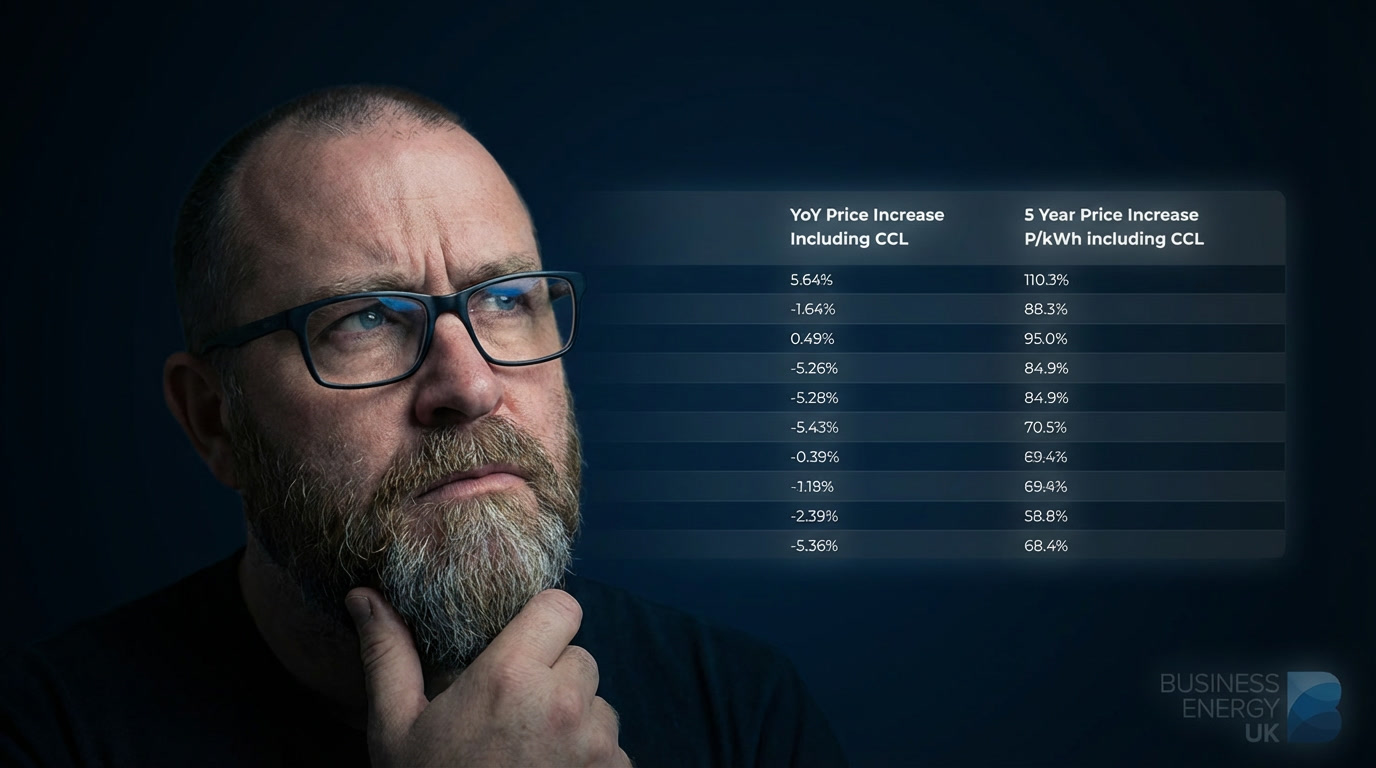
- Over 5 years, electricity prices rose sharply:
- Small businesses: +100%+
- UK average: +68.4%
- This far exceeds general inflation (28.7%), meaning energy costs are rising much faster than overall prices.
- Over 5 years, electricity prices rose sharply:
Recent Developments
- Wholesale electricity prices were stabilizing earlier in 2026.
- After the Iran conflict escalation, prices spiked sharply again, driven by rising gas costs.
- Still not as severe as peaks during the Russia–Ukraine war, but could worsen.
Government Response
- The UK has an energy price cap, but:
- It applies only to households, not businesses.
- Domestic cap: ~24.67p/kWh, which is lower than business rates.
- No confirmed business support scheme yet.
- Rachel Reeves has suggested possible help, but currently focused on households.
Impact on Businesses
- Businesses face higher and rising costs with no protection.
- Even the best available deals (~29.9p/kWh) can be higher than previous averages.
Advice Given
- Businesses should:
- Reduce electricity usage
- Shop around for better tariffs (especially if paying >30p/kWh)
- Future relief depends on whether the government introduces support measures.
Overall Takeaway
UK business electricity prices remain highly sensitive to global energy markets. The current geopolitical tensions are pushing prices upward again, and unlike households, businesses currently have limited protection and must manage costs independently.
Video description:
This video looks at what’s happening to commercial electricity rates in the UK in 2026 as a result of the price shocks caused by the US-Iran war.
Sources:
Business Energy UK: https://www.businessenergyuk.com/business-electricity/
National Grid Live: https://grid.iamkate.com
BoE: https://www.bankofengland.co.uk/monetary-policy/inflation/inflation-calculator
Ofgem: https://www.ofgem.gov.uk/news/changes-energy-price-cap-between-1-april-and-30-june-2026
Ofgem: https://www.ofgem.gov.uk/news-and-insight/data/data-portal/wholesale-market-indicators
Trading Economics: https://tradingeconomics.com/united-kingdom/electricity-price
BBC: https://www.bbc.co.uk/news/articles/cr516nmer5eo
Full video Transcript:
So today we’re talking about what’s happening with business electricity prices in the UK in relation to the Usis Israel War on Iran. So, let’s see here headlines that Donald Trump has what’s the end of whole of civil civilization. This seems to be a pointless war. But it’s not immediately obvious maybe why this is having an impact on electricity prices here in the UK Quite simply, that’s because.
The UK actually generates a lot of its electricity from gas. So, if you go here, so you can see this is the current live rate when I’m recording this video, just 10.7% of electricity is coming from gas, a lot from solar, wind, and hydro just over 50%. But if you look over the past year, gas is provided 27.4% of the UK’s electricity use.
So obviously a spike in that is going to cause a massive spike in electricity prices overall. So, looking here at Business Energy UK, what are businesses currently paying? So, they have data going back to Q4 2025. So, this is before all this started. So very small businesses were paying an average of 36 point 11 pence per kilowatt hour for their electricity with large businesses paying less.
The average for all UK businesses as a whole was 23.99 pence per kilowatt hour. And this has been trending up over time. Here you can see these graphs are showing that the prices were really spiked in in recent years. And the good news going into this year is that prices were actually falling.
The UK average price year on year had actually fallen 5.3%. I see this little dip here towards the end year on year. But if we look at the five-year price increases, they’re absolutely massive for small businesses, over a hundred percent increase in the price for electricity over just five years.
And even the UK average is 68.4%, which is just crazy. So, if we look at the Bank of England inflation calculator over that time. Overall inflation, total inflation for that time is 28.7%. The five-year increase is more than double that. For the u the average UK assessment, small businesses are basically seeing their prices go up by more than triple the rate of inflation.
And we can see here the differences too. The best deal going right now. So, we saw that the average. The end of Q4 was 23.99 pence per kilowatt hour. And the best deal to have going here, so they claim is 29.9 pence per kilowatt hour for small businesses, which is lower than what the average small business was paying before had been 26.6 pence per kilowatt hour for really large businesses, which is higher than this.
So, the impact of this is going to be. Pretty massive. So, what is the UK government doing, if anything, about this? So, you probably know about the energy price caps, but this is only for domestic consumers and not for businesses. So, if you look at the electricity rate portion here, they’re actually capped at 24.67 pence per kilowatt hour.
A standing charge of 57 point two, one pence per day. So, if you look at small businesses. That’s actually quite a bit lower. That’s lower than the lowest rate you can get here. And these rates are going to apply for the next three months until the 30th of June 2026. But it really doesn’t help businesses at all.
So, if you’re looking here at the wholesale energy prices for electricity, we have this is from off gm. They have everything going up right up until January before all this started. So, it looked like we had a nice flat sort of thing here. Wholesale prices looking good. And then if we look actually with more recent data, we can see here that there’s a big spike here right after the war in Iran starts here, so we can just see the electricity prices just go through the roof.
And again, that’s the cause by the increase in price of gas. However, if we go back five years. It’s not quite as bad as it was during the initial phases and for multiple phases of the war in Ukraine. So, we’re still not training so badly, but obviously this could, it could get a lot worse, which is not great.
So, is the government doing anything right now? Rachel Reeves has said that she has plans for energy bill help for those who need it most. But as of right now, as of recording, that was only for. Consumers domestic consumers and not businesses. There was no plan to replicate the various bill relief schemes that helped during the Ukraine initial phases of the Russia, Ukraine war.
What can you do besides this? The, pretty much the only thing you can do is either reduce your electricity usage or get a quote to a lower price provider if you are paying higher than, then these rates here. So, if you’re paying more than say 30 pence per kilowatt hour for electricity, you should definitely go get a quote.
You can either get a quote here from Business Energy UK or there’s tons of other kind of online brokers available that will give you quotes for free and compare rates besides that. Just reduce your electricity usage and just cross the fingers that Rachel Reefs comes in with a.
Some sort of support package if energy prices stay high for the long term. So, I’d love to know your thoughts about the recent kind of energy crisis, how it’s affecting your business and what the government should do about it. Please leave your comments below.
Leave a Reply