
Video Summary
Summary: UK Business Gas Prices & Iran–US Conflict Impact
- The video explains how the US–Iran conflict is pushing up global gas prices, largely due to risks around the Strait of Hormuz, a key route for oil and gas shipments.
- This disruption is causing a spike in UK business gas prices, as the UK is exposed to global energy markets.
Pre-War Gas Prices (Q4 2025)
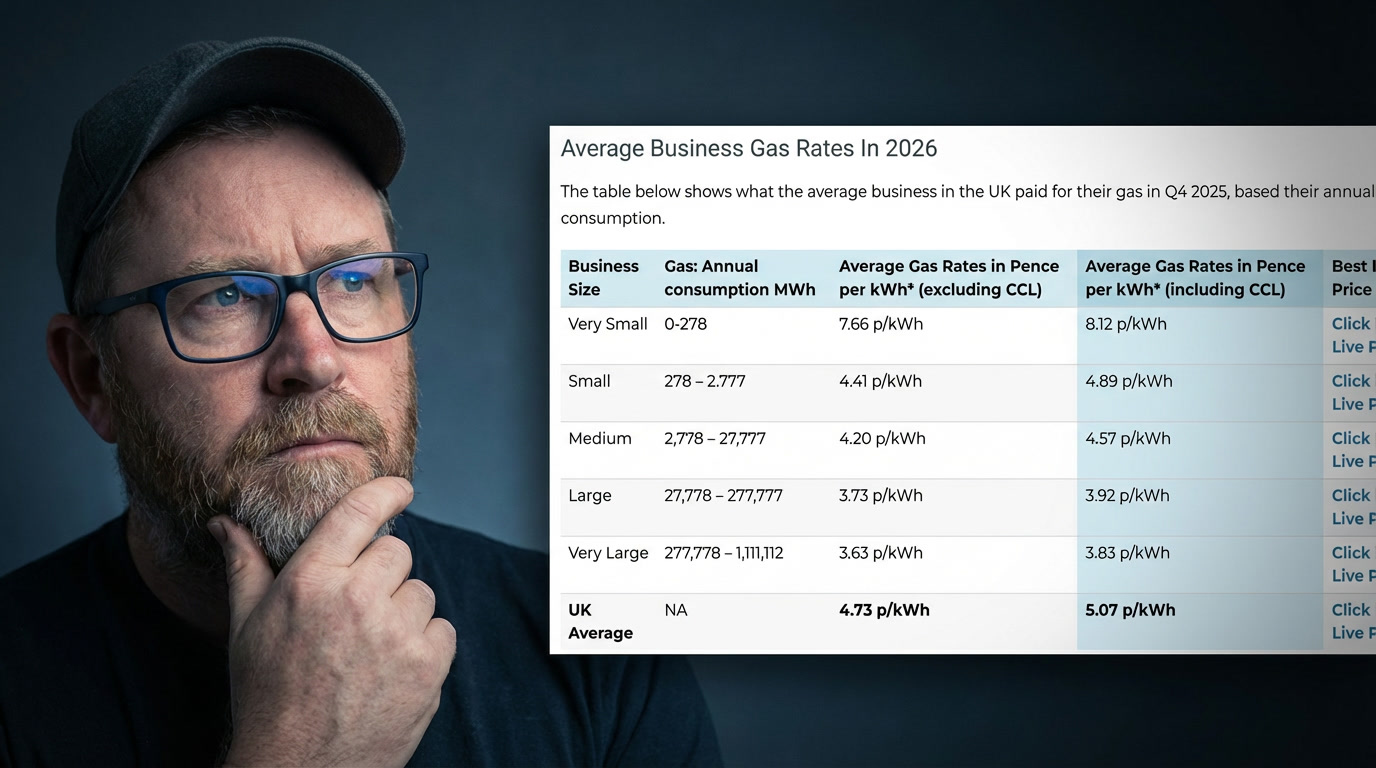
- Very small businesses: ~8.12p/kWh
- Large businesses: ~3.83p/kWh
- UK average: ~5.07p/kWh
- Larger businesses benefit from lower, more efficient pricing structures.
Price Trends
- Before the conflict:
- Prices were falling, with businesses paying ~8% less year-on-year.
- However, over 5 years:
- Small businesses: +73.2%
- Large businesses: +127.5%
- This far exceeds inflation (28.7%), showing energy costs rising disproportionately.
Current Situation (Post-Conflict Spike)
- Prices have surged:
- Small businesses now seeing ~9.6p/kWh
- Large businesses around ~8.1p/kWh
- Wholesale gas prices show a sharp spike, with only slight recent declines.
- The spike is smaller than the peaks during the Russia–Ukraine war, but still significant and uncertain.
Government Policy
- The UK energy price cap:
- Applies only to households, not businesses.
- Domestic gas cap: ~5.74p/kWh (much lower than business rates).
- Rachel Reeves has mentioned potential support, but:
- Focus is currently on domestic consumers
- No confirmed help for businesses yet.
Impact on Businesses
- Businesses face sharp cost increases with no price cap protection.
- Even the best available deals are now higher than pre-war averages.
Advice for Businesses
- Two main strategies:
- Reduce gas usage
- Improve efficiency, reduce heating, upgrade equipment
- Seasonal relief expected as summer reduces demand
- Switch or renegotiate suppliers
- Compare tariffs and consider locking in rates
- Short-term vs long-term contracts depend on expectations of future prices
- Reduce gas usage
Outlook
- It’s unclear whether this spike is temporary or long-term.
- Prices remain volatile due to geopolitical uncertainty.
- Businesses must act independently while waiting to see if the government introduces support.
Overall Takeaway
The Iran–US conflict has triggered another surge in UK business gas prices. While not yet as severe as past crises, the lack of government support for businesses means companies must actively manage costs and risk in an unstable energy market.
Video Description:
This video looks at what’s happening to commercial gas rates in the UK in 2026 as a result of the price shocks caused by the US-Iran war.
Sources:
Business Energy UK: https://www.businessenergyuk.com/business-gas/
CNN: https://edition.cnn.com/2026/03/20/politics/us-strait-of-hormuz-avert-closure-iran
BoE: https://www.bankofengland.co.uk/monetary-policy/inflation/inflation-calculator
Ofgem: https://www.ofgem.gov.uk/news/changes-energy-price-cap-between-1-april-and-30-june-2026
Ofgem: https://www.ofgem.gov.uk/news-and-insight/data/data-portal/wholesale-market-indicators
Trading Economics: https://tradingeconomics.com/commodity/uk-natural-gas
BBC: https://www.bbc.co.uk/news/articles/cr516nmer5eo
Also see: Why Are UK Business Electricity Prices So High In 2026?
Full Video Transcript
Today I’m talking about the impact of the Iran US war in its effect on gas prices, business, gas prices here in the UK. You can see, unless you’ve been living on Iraq, you know that this war’s been going on for a while now. They’ve obviously been trying to prevent the closure of the Straits of Fores.
Seems to be a tough situation here. Obviously, that’s caused gas prices to spike and so much of the world’s oil and gas comes through there. So, what has been going on with business gas prices in the UK over the last little while? So here we are in Business Energy UK, and they have the gas prices for different business sizes here.
So very small businesses pay with a climate change levy. They pay on average at the end of Q4 2025. So, this is before all the started, we’re paying. Eight point 12 pence per kilowatt hour. Very large business is paying a much lower rate of only 3.83 pence per kilowatt hour. The average UK business paying around five what oh seven pence per kilowatt hour for gas.
Now, obviously this is, these are the rates that we saw before. The war going on. So, here is the kind of overall pricing trend. Small businesses just really getting hammered with high prices here. Whereas larger businesses that are a bit more sophisticated have actually seen kind of declining prices in recent times, although significantly higher than they were pre pandemic and pre–Russian War with Ukraine.
So, you can see here their prices were actually coming down from across the board for businesses, actually large businesses, seeing the biggest savings. The average business in Q4 2025 was actually paying 8% less for their gas compared to Q4 2024. However, if you look at the five-year increase, it’s still massive.
So, 73.2% for small businesses and, 127.5% for large businesses. Now, to put that into some perspective, the overall inflation over that period of time was just 28.7%. So, energy prices really are soaring way above what inflation is. And as you can see here. That the best deal. So, the average small business was paying eight point 12 pence per ki an hour at the end of Q4.
The best deals in the market now because of the massive price increase recently is 9.6 pence per kilowatt hour for small businesses, and even large businesses are still looking around the eight. One pence per kilowatt hour for their gas prices. So just a massive spike here.
So, this is, it’s remains to be seen if this is going to be transient or if it’s going to be a long-term price spike here. And if we compare this to the energy price cap, now the energy price cap does not apply to businesses. It only applies to consumers and they have a capped.
If you’re on a direct debit, you only pay 5.74 pence per kilowatt hour for your gas for the next three months. So that’s better than a lot of. It’s certainly better than the smallest businesses actually above what some other businesses were paying, but you can see it’s much, much lower than what the best deals are in the market for businesses right now.
We’ll see if the government will provide any support to that. But again, if you look at, we’ve, okay, hold on here. If we see the wholesale market prices for gas leading up to this, there’s very, we actually had a really nice, stable kind of run here. The, I think the government was pretty happy.
To see gas prices pretty, pretty level here. But if we look at the recent things here, look, boom massive price spike. It is coming down a little bit but not as much as nowhere near to where it was before all this sort of stuff happened. The one piece of good news is that if we look back at a five-year thing, this blip is actually quite small.
So, the massive spikes caused by Russia’s invasion of Ukraine. We’re actually a bigger deal than what this is so far proven to be, although that remains to be seen where we go. Obviously during this period here, the government was providing various support schemes and I’m not sure if they’re going to do anything of that.
Rachel Reeves has, the only thing she said is that she plans for energy bail help for those who need it most. Now in this article here, it’s talking about domestic customers and not business customers. So, I don’t know if you think small businesses deserve it most or. Other people deserve it more.
But you can see that this is going to be a pretty massive cost. So, what can you do as a small business? You basically have two real options unless the government comes in. But I wouldn’t be waiting for that or holding my breath for that. You either have the option to reduce your gas usage if there’s any kind of efficiencies you can get, but like more efficient.
Equipment or machinery or anything like that uses less gas or just turning down heating, we’re obviously going into the summer, so we will be using less gas naturally. Or the other option is basically just to price compare what the best rates are in the market. Now, you might want to just if you think prices, this is a blip.
You might want to lock in your rate, maybe just for a year or something like that. You can go into a variable rate, but those are usually really high. Or if you think this is going to be a longer term thing, you can lock in now, while rates haven’t massively spiked as much as they did before, obviously when we look back here, so it’s obviously, I, you can’t predict where prices will go because Donald Trump himself is so unpredictable, so who really knows what’s going to happen?
But those are your options. I’d love to know your thoughts about where you think, business gas prices are going to go in the next year or so, what your, the impact it’s having on your business and what you think the government should be doing about it. Love to read those comments in the comment section below.
Thanks.
Leave a Reply